
Almost everyone looks. A few days after an extraction you find a mirror and a phone flashlight, and then you’re staring at a hole in your gum wondering whether what you’re seeing is fine or a problem.
A normal socket after tooth extraction goes through a predictable sequence of appearances, and several of those stages look alarming even when healing is going perfectly. Here’s what each stage actually looks like, and how to tell a normal socket after tooth extraction apart from dry socket.
What a Normal Socket After Tooth Extraction Looks Like
Right after surgery, a blood clot forms in the socket. Over the following days that clot changes colour and texture, and eventually gum tissue grows across it. The short version: a healing socket should look progressively less like an open hole and progressively more like gum.
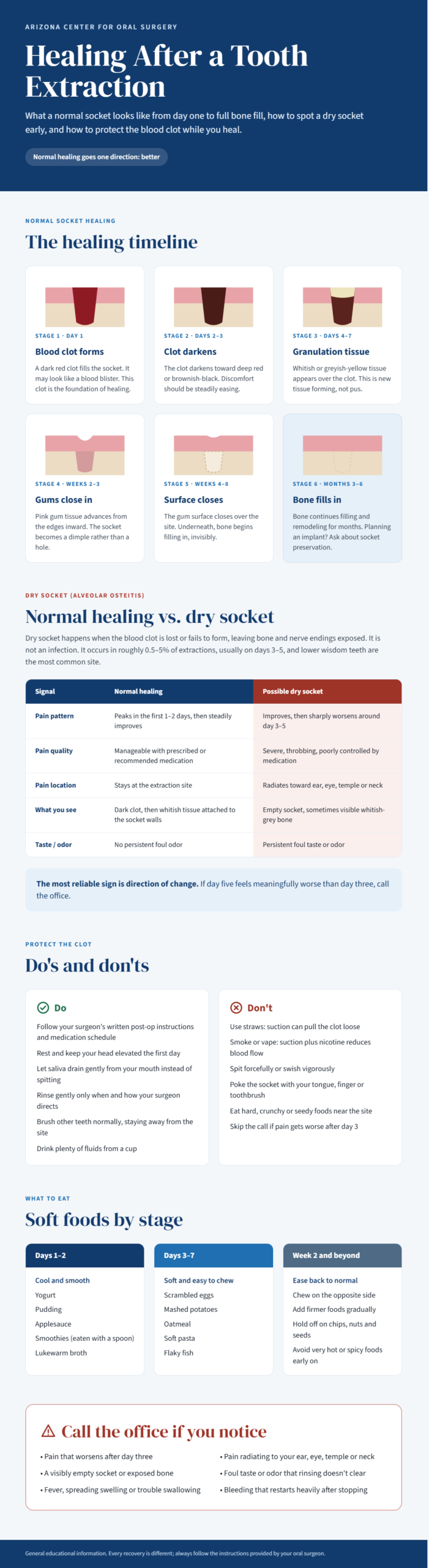
Day 1
A dark red clot filling the socket. It may look like a blood blister. This is exactly right and it is the single most important structure in your recovery.
Days 2–3
The clot darkens toward deep red or brownish-black. Many patients panic here and assume something has gone wrong. A dark clot is a healthy clot.
Days 4–7
Whitish or greyish-yellow tissue appears over or around the clot. This is granulation tissue, new tissue forming, and it is not pus, despite looking the part. Any lingering taste should be mild. The socket starts to look shallower.
Weeks 2–3
Pink gum tissue advances from the edges inward. The socket becomes a dimple rather than a hole. Food still gets caught, which is annoying but expected.
Weeks 4–8
The surface closes over. Bone continues filling in underneath for months, invisibly.
Upper and Lower Sockets Heal Differently
Lower molar sockets are deeper, sit in denser bone, and collect more food. They also account for most dry socket cases. Expect a lower socket to look like an open hole for longer than an upper one, that’s anatomy, not a problem.
Upper sockets tend to close faster and look tidier sooner. They carry a different concern instead: proximity to the maxillary sinus. If an upper molar was removed, your instructions likely include sinus precautions, and the warning signs to watch for are different from the ones below.
Normal Socket vs. Dry Socket: The Comparison
| Signal | Normal healing | Dry socket |
|---|---|---|
| Pain direction | Improves steadily after day 2–3 | Improves, then sharply worsens around day 3–5 |
| Pain quality | Dull, manageable, responds to medication | Severe, throbbing, poorly controlled by medication |
| Pain location | Stays at the site | Radiates toward ear, eye, temple, or neck |
| What you see | Dark clot, then whitish granulation tissue | Empty socket, sometimes visible whitish-grey bone |
| Taste and odor | Mild, clears with rinsing | Persistent foul taste or odor |
| Timing | Continuous improvement | Onset typically day 3–5 |
The most reliable single indicator is direction of change. Healing goes one way. If day five is meaningfully worse than day three, that’s the signal, regardless of what the socket looks like.
The Whitish Tissue Almost Nobody Warns You About
The most common reason patients call worried is white or yellowish material in the socket around day four to seven. It looks like infection. In the overwhelming majority of cases it’s granulation tissue doing exactly what it should.
Distinguishing features of normal granulation tissue: it’s attached to the socket walls rather than floating loose, it isn’t accompanied by escalating pain, and there’s no persistent foul odor. Genuine infection generally brings fever, spreading swelling, and pain that climbs.
What Dry Socket Actually Is
Dry socket (clinically, alveolar osteitis) happens when the blood clot is lost or fails to form properly, leaving bone and nerve endings exposed. According to the National Library of Medicine’s StatPearls review, incidence is most commonly reported between 0.5% and 5% of extractions, though rates vary considerably across studies and patient groups.
One correction worth making, because it drives the wrong response: dry socket is not an infection. It’s delayed healing caused by clot loss. That’s why antibiotics aren’t the treatment. What helps is having the socket irrigated and a medicated dressing placed; an in-office visit that usually brings dramatic relief within an hour or two.
Lower wisdom teeth are the most common site. Smoking, straw use, forceful rinsing, and difficult surgical extractions all raise the risk.
Why the Clot Comes Out
Almost always mechanical or chemical:
- Suction: straws, smoking, vaping
- Negative pressure: forceful spitting or vigorous swishing
- Nicotine, which reduces blood flow to the healing site
- Disturbance: poking with a tongue, finger, or toothbrush
- Surgical difficulty: deeply impacted teeth requiring more manipulation
The first three are within your control and account for most preventable cases. The full timeline of what’s safe when is covered in our guide to eating and drinking after oral surgery.
Does the Socket Look Different After PRF or a Graft?
Yes, and it catches people off guard. If graft material or a membrane was placed, the socket may look white, tan, or granular from day one; nothing like the dark clot described above. Small particles occasionally work loose and appear in your mouth over the first week.
If platelet-rich fibrin was placed, expect a pale yellowish plug that looks nothing like a blood clot. Again, normal.
The rule doesn’t change: judge by pain direction, not appearance. A grafted socket that looks unusual but hurts progressively less is healing. Any socket where pain climbs after day three needs attention, whatever it looks like. If you’re unsure what was placed during your procedure, call and we’ll tell you, it’s in your chart.
How We Reduce the Risk
Beyond technique, two options can help in higher-risk cases.
Platelet-rich fibrin uses a concentrate from your own blood, placed directly into the socket to support clot stability and healing. It’s drawn and prepared during your appointment, so nothing foreign is introduced.
Where preserving ridge shape matters, particularly if an implant is planned, socket preservation places graft material at the time of removal. It protects the site and maintains the bone volume an implant will later need.
Both are decisions made during planning, which is one reason routine tooth extractions and wisdom teeth removal are worth having done by an oral and maxillofacial surgeon rather than treated as an afterthought.
When to Call Us
- Pain that worsens after day three
- Pain radiating to your ear, eye, temple, or neck
- A visibly empty socket, or what looks like exposed bone
- Persistent foul taste or odor that rinsing doesn’t clear
- Fever, spreading swelling, or difficulty swallowing
- Bleeding that restarts heavily after having stopped
Dry socket resolves considerably faster when treated. There’s no benefit to waiting it out, and the office visit is straightforward.
Frequently Asked Questions
What should a normal extraction socket look like?
A dark red or brownish clot for the first few days, then whitish-grey granulation tissue from roughly day four, then pink gum tissue closing inward over weeks two and three. It should look progressively shallower.
How soon after extraction does dry socket usually start?
Typically between day three and day five, after an initial period of normal improvement. Sudden worsening in that window is the classic presentation.
Is dry socket an infection?
No. It’s delayed healing caused by loss of the blood clot, which exposes bone and nerve endings. That’s why antibiotics generally aren’t the treatment, irrigation and a medicated dressing are.
Does dry socket heal on its own?
It’s self-limiting and will eventually resolve without treatment, but the pain can be severe and may last a week or more. In-office treatment usually brings relief within hours, so there’s little reason to endure it.
Why did my blood clot come out?
Most commonly suction from a straw or smoking, forceful spitting or rinsing, or physically disturbing the site. Difficult surgical extractions also carry higher baseline risk.
Not Sure What You’re Looking At? Send Us a Photo
If something looks wrong, we would far rather hear from you on day four than on day nine. A quick look costs you nothing and settles the question.
Patients across Phoenix sometimes wait several days hoping a normal socket after tooth extraction will simply declare itself one way or the other. It usually doesn’t, but a two-minute look at the site does.
Arizona Center for Oral Surgery serves patients across the Phoenix metro, including Glendale, Peoria, Surprise, and North Phoenix, from our office at 18301 N. 79th Ave., Building G, Suite 185, Glendale, AZ 85308.
Call (623) 931-9197, request an appointment online, or contact our office.
This article is for general education and is not a substitute for individual medical advice or examination. If you are concerned about your healing, contact your surgeon directly.
