
The wisdom teeth removal recovery timeline is the thing almost every patient wants pinned down before surgery day- not the procedure itself, but what the week after actually looks like. When does the swelling stop? Which day is the worst? When can you stop planning your life around your face?
Here’s the honest version of the wisdom teeth removal recovery timeline, day by day, plus what healing in Phoenix looks like. Recovery here isn’t quite the same as recovery in a humid climate, and the difference matters more than most post-op sheets admit.
How Long Does Wisdom Teeth Recovery Take?
Most patients following a standard wisdom teeth removal recovery timeline feel substantially better by day four or five and close to normal within one to two weeks. Full healing, though, takes considerably longer; the American Association of Oral and Maxillofacial Surgeons notes that jawbone and gum tissue can take up to six weeks to fully heal.
Those two numbers can be confusing, so it’s worth separating them. Feeling fine and being healed are different milestones. You’ll be back at work long before the socket has finished closing underneath.
The Wisdom Teeth Removal Recovery Timeline, Day by Day
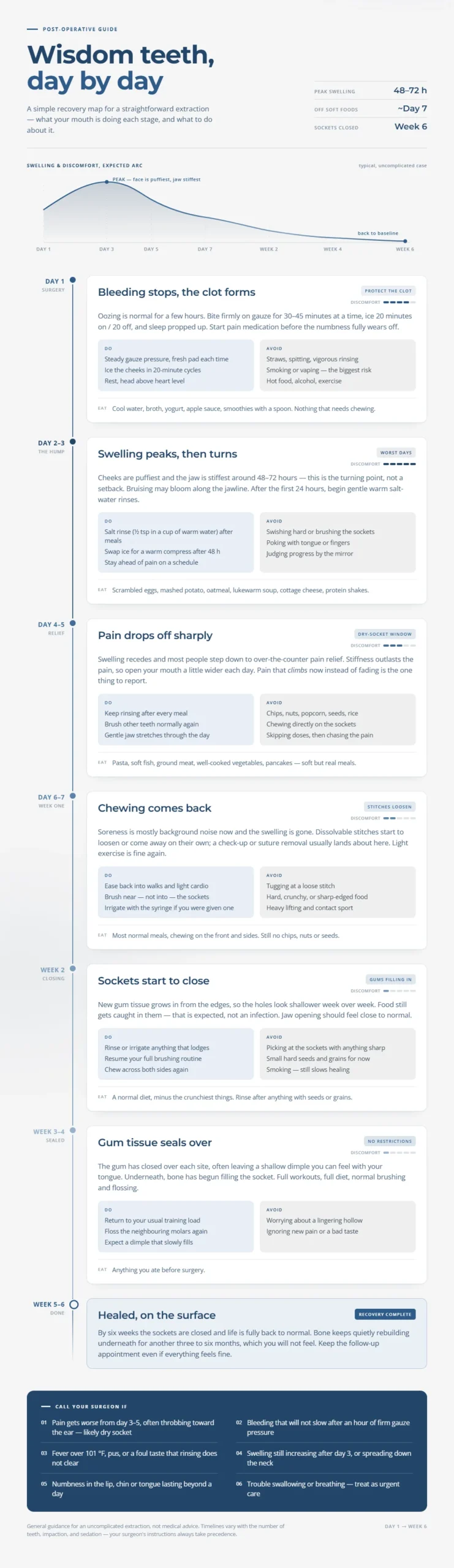
Day 1: The First 24 Hours
Expect grogginess from anesthesia, gauze changes, and light bleeding that tapers through the evening. Swelling has barely started. Keep an ice pack on and off against your cheeks; AAOMS recommends intermittent cold for the first 48 to 72 hours. Eat nothing that requires chewing. Sleep with your head elevated.
The most important job today is protecting the blood clot forming in each socket. No straws, no spitting, no smoking, no vigorous rinsing.
Bleeding usually slows within a few hours. Firm, steady pressure on fresh gauze works better than changing it constantly; every swap disturbs what’s forming underneath. A moistened black tea bag can substitute for gauze if oozing persists; the tannins help constrict small vessels.
Days 2–3: Peak Swelling
This surprises people: you will likely look and feel worse on day two or three than you did on day one. That’s normal and expected. Swelling typically peaks around 48 to 72 hours, and bruising along the jaw or neck can show up now too.
Jaw stiffness makes opening your mouth difficult. Start gentle warm salt-water rinses: a half teaspoon of salt in a glass of warm water, letting it fall out of your mouth rather than spitting. Switch from ice to warm compresses once swelling has peaked.
Days 4–5: The Turn
This is where most patients notice the corner turning. Swelling starts visibly receding, pain becomes intermittent rather than constant, and many people step down from prescription pain medication to over-the-counter options.
If your pain is increasing on day four or five instead of decreasing, that’s the classic dry socket window. Don’t wait it out; call us.
Days 6–7: Feeling Human
Most patients are back to work or school, eating soft-solid foods, and opening their mouths close to normally. The sockets are still open depressions and will trap food. Gentle rinsing after meals becomes part of your routine for the next few weeks.
Weeks 2–6: Quiet Healing
Gum tissue closes over the sockets during weeks two and three. Underneath, bone fills in gradually over the following weeks. You’ll feel normal well before this is finished. Small bone fragments occasionally work their way to the surface during this period; irritating, usually harmless, and worth mentioning at your follow-up.
Food will keep collecting in the sockets until they close. A gentle rinse or a plastic irrigating syringe, if we gave you one, handles it. Don’t use anything rigid to dig material out.
One Tooth or All Four? The Timeline Shifts
The wisdom teeth removal recovery timeline above describes a typical four-tooth extraction, which is what most patients have. Fewer teeth generally means a gentler week.
- A single erupted tooth often resolves in three to five days with modest swelling.
- Two teeth on one side lets you chew on the other, which makes eating dramatically easier, though the asymmetric swelling looks more dramatic in the mirror.
- All four, fully impacted, sit at the long end of every range here. Bone removal and sectioning of the tooth mean more surgical trauma and a slower first week.
- Lower teeth generally swell more and hurt more than uppers. Most of the dry socket risk sits with the lowers, too.
Upper molars come with their own consideration: proximity to the maxillary sinus. If yours were close, your recovery includes restrictions most patients have never heard of.
Managing Pain Without Leaning on Opioids
Most patients need far less prescription medication than they expect. Current practice favors scheduled non-steroidal anti-inflammatories combined with acetaminophen, which for dental pain performs comparably to opioid options for many people, without the sedation or dependency concerns.
The key word is scheduled. Taking medication on a clock for the first 48 hours keeps pain from building; waiting until it hurts means chasing it all day. Set alarms, including one overnight for the first night.
Ice works on the same principle. Twenty minutes on, twenty off, repeatedly through the first two days, not one long session when swelling appears. If we prescribed something stronger, use it for the first night or two and step down as soon as you reasonably can.
Recovering Through a Phoenix Summer
Standard recovery instructions assume a temperate climate. Phoenix isn’t one, and three things change here.
Dehydration Works Against Your Clot
You can’t use a straw, you’re on soft foods, and it’s 110 degrees outside. That combination makes dehydration far easier than patients expect. Dehydration thickens saliva, worsens dry mouth, and makes the whole first week more miserable. Drink directly from a glass, steadily, all day.
Heat Makes Swelling Worse
Stay indoors and air-conditioned for the first three or four days. Heat exposure increases facial swelling and makes the peak on days two and three noticeably harder. This is not the week for yard work.
Timing Around the Calendar
If surgery is elective, the recovery week matters. Many Phoenix-area families schedule around school breaks, and summer is popular for exactly that reason; though summer also means the heat considerations above. Our guide on choosing the right time of year for wisdom teeth removal goes deeper on the tradeoffs.
Signs Your Recovery Is Off Track
Call our office promptly for any of these:
- Pain that increases after day three rather than decreasing – the most common dry socket signal
- Pain radiating toward your ear, eye, temple, or neck on the surgical side
- Swelling that worsens after day four, or spreads toward your eye or down your neck
- Fever, or difficulty swallowing or breathing
- Bleeding that soaks through gauze and won’t slow after several hours
- Numbness in your lip, chin, or tongue persisting well beyond the day of surgery
- A foul taste or odor that rinsing doesn’t clear
Dry socket is the complication patients ask about most. AAOMS puts it at roughly 4 percent of extractions, uncommon, but common enough that recognizing it early is worth knowing how to do.
What Actually Speeds Recovery
Very little shortens the biology. What you can control is avoiding the things that extend it:
- Protect the clot above all else. No straws, smoking, vaping, or forceful spitting for at least a week. This is the single highest-impact thing you do.
- Stay ahead of pain rather than chasing it. Take medication on schedule for the first two days instead of waiting for pain to build.
- Ice for 48–72 hours, then switch to warmth. Ice after day three does little; gentle heat helps stiffness.
- Eat real calories. Healing is metabolically expensive. Smoothies (spooned, not sipped through a straw), soups, eggs, and yogurt beat skipping meals.
- Keep the follow-up. It’s how we catch problems while they’re still small.
Sedation choice also shapes day one. Patients who have IV sedation or general anesthesia typically remember nothing of the procedure but need a longer, groggier day one and a driver. That tradeoff is worth discussing at your consultation.
Why the Surgeon Matters More Than the Timeline
Recovery depends heavily on how the extraction was planned. Impacted third molars sitting against the inferior alveolar nerve, or upper molars tenting into the sinus, carry risks that a flat X-ray can miss entirely.
We plan every case with cone beam CT imaging so we know exactly what we’re working around before we start. For upper molars, that also means knowing whether sinus precautions will apply to your recovery. Clean, well-planned surgery is the most reliable path to an uneventful week.
If you haven’t had your consultation yet, our guide to what to know before wisdom teeth removal covers preparation, and the wisdom teeth removal page explains how we approach the procedure itself.
Frequently Asked Questions
How long is the wisdom teeth removal recovery timeline?
Most patients feel close to normal within one to two weeks, with the sharpest improvement between days four and seven. Complete healing of bone and gum tissue can take up to six weeks, though you won’t notice that final stage.
When does swelling peak after wisdom teeth removal?
Swelling typically peaks 48 to 72 hours after surgery, meaning day two or day three is usually when you look and feel worst. It should visibly recede from day four onward.
Which day after wisdom teeth removal is the worst?
Day two or three for most patients, because swelling and jaw stiffness peak together. Day one often feels deceptively manageable while anesthesia and initial medication are still working.
When can I stop taking pain medication?
Many patients step down to over-the-counter medication around day three or four and stop entirely within a week. Take prescribed medication as directed, and tell us if you still need it beyond a week.
How do I know if my recovery is off track?
The clearest signal is direction. Pain and swelling should improve after day three. Anything that gets worse instead of better after that point warrants a call, even if it seems minor.
Talk to a Phoenix Oral Surgeon
Recovery goes best when you know what to expect and have somewhere to call when something feels off. We’re available for both, and a Phoenix patient who calls on day four with a question is never a bother.
Arizona Center for Oral Surgery serves patients across the Phoenix metro, including Glendale, Peoria, Surprise, and North Phoenix, from our office at 18301 N. 79th Ave., Building G, Suite 185, Glendale, AZ 85308.
Call (623) 931-9197, request an appointment online, or contact our office with a question.
This article is for general education and is not a substitute for individual medical advice. Always follow the specific post-operative instructions provided by your surgeon.
